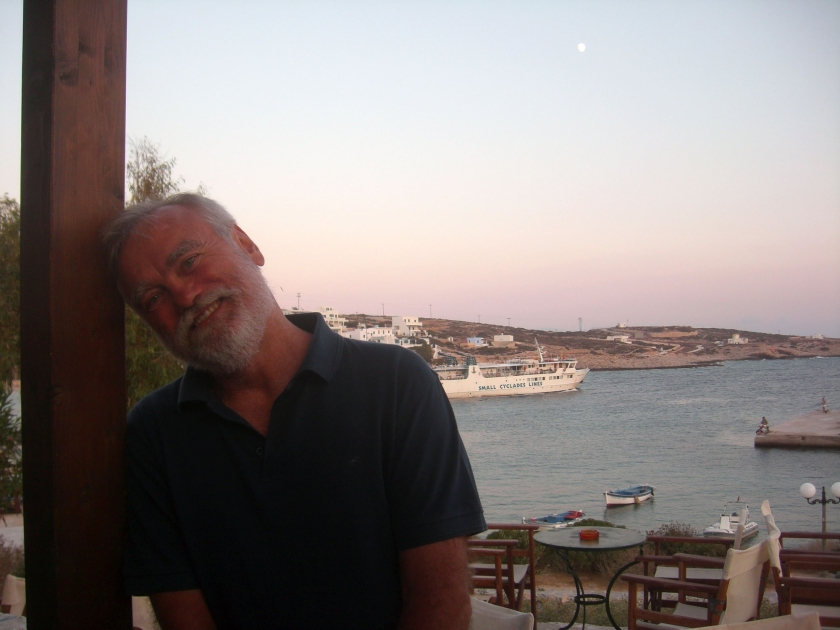
Don Schofield’s[1] latest publication titled From the Cyclops Cave: A Braided Memoir (Open Books 2025) has an immediate impact on the reader. From the opening pages, the strength and clarity of the speaking voice boosts the emotional power and affective richness of the narrative, while the experiences disclosed lead the reader to a journey of self awareness and insightfulness.
Schofield’s narrative composition takes place in different locations and temporalities with memory serving as the driving force that smoothens the transition from the narrator’s childhood to adulthood, as well as wandering in California and the island of Kythnos. This is what facilitates the perspectival shifts that one comes across while moving between the book sections being read both as vignettes, in other words as a temporal and spatial snapshots of the narrator’s autobiographical accounts, or as short stories in which the strengths and weaknesses of each participating character is displayed in their effort to gain a fuller sense of self, while interacting with peers, siblings, acquaintances or even strangers, plus with their inner and outer surroundings.
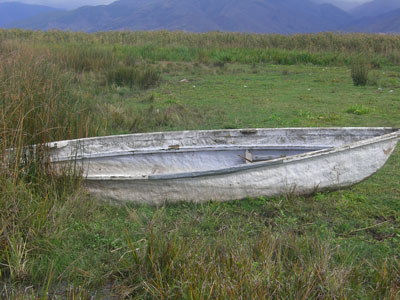
Boat in a barley field, Kouri Bay, Kythnos.
Personally, as I was moving through the narrative page by page and chapter by chapter, I came across certain phrases and paragraphs that caught my attention, as is the case of the reoccurring articulation of emotion evident here – “Still waiting for that greater love” (212, 310) – or of the meditative exposure of self that appears early in the book as shown below:
Turning the days of my childhood over in my mind, all those months and years in California, home to home, moment to moment, face to face – I try to piece together those fragments into whole scenes, filling in the gaps as best I can. The effort, though, is always futile, probably because I don’t know whole is. Can’t say I’ve ever really felt it. But I’m not just trying to make sense of my past. I need to see as well – clearly, fully – if, despite that past, I have a future that’s salvageable. If someone with a history like mine can ever really love and be loved, or if, like that mule going round this threshing floor, I’m doomed to repeat, over and over, the same destructive patterns as those who supposedly raised me, and those before them. (9-10)
The emphasis that the excerpts above place on the effort of the speaking voice to “piece together” the “fragments into whole scenes” in addition to detecting the “destructive patterns” that impact on one’s effort to find “greater love” highlight a specific kind of tension that one traces when reading specific kind of stories characterized as autobiographies or memoirs or self writings. Schofield himself, using in the title of his book the words “braided memoir,” reveals not simply his interest in offering his readers an account of his interweaving personal experiences in Greece and the US, but in enabling us to come to terms, as Daniel Worden would say in his analysis of “Memoir” writings, of an “authentic way of being in the world, while also acknowledging the mediations that make that authenticity so difficult to capture” (126). Indeed, the interwoven memoir Schofield writes, consisting of multiple fractured threads of life incidents, enables him to revisit his personal life encounters and occurrences while capturing those moments of ambiguity and blurriness that every person wrestles with or comes in dire confrontation with in the course of their life’s journey.
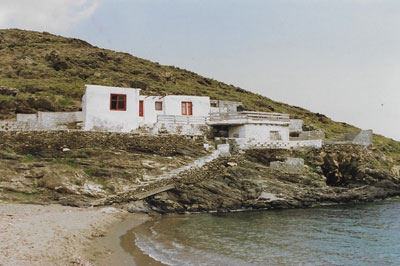
The Cyclops Cave in 1994. The back wall of the main structure (on the left), where Don Schofield lived, was a cave in the mountainside, whitewashed. Thus the name.
When it comes to memoir writing itself, the book From the Cyclops Cave can be approached in the context of the current surge noticed in the American literary scene nowadays with regard to memoir publications, starting in the 1990s and escalating in the 2000s. The resurgence of the specific literary genre reveals the renewed interest that is detected currently in the “authentic story of a memoirist’s journey that [the readers] can then translate to their own struggle to lead a better life” (Worden 127). However, the reference in the preceding citation to a “better life” does not suggest the existence of any ready-made solutions of ensured improvement, but the empathetic identification one experiences when reading about somebody else’s challenging and traumatic life stories. This is exactly what turns the publication of a memoir book into an experience of self-discovery and self-orientation, and, specifically, what turns the narration communicated to the readers via the memoirist’s speaking voice into a confession of the ongoing doubts one experiences about their life course and choices.
In Schofield’s book, this is exactly the sense that the title chosen, From the Cyclops Cave, emanates. Approaching the title from a figurative point of view, one can see in their mind’s eye the mythical one-eyed giant who even though can see everything from above, the breadth of vision offered is limited, with the cave within which the creature lives keeping it withdrawn, invisible, forgotten from any kind of societal interaction. The significance of Schofield’s memoir lies exactly in this figurative approach where the speaking voice, even though it is distinctly visible throughout the narrative, it struggles to retrieve from memory, as documented via the narrative, all the experiences that have been pushed, either consciously or unconsciously, into an emotional and psychological cave that has been kept for a long time out of sight. At a point in the book From the Cyclops Cave, readers come across the following statement and questions: “I was ready, on the sweltering afternoon in August of 1980, to do whatever it took to stay in this country [meaning Greece] that had mesmerized me four years earlier with its landscape, its layers of associations with my own life […] why did I come? What was I after? What could possibly have led me to sell almost everything I owned […] to come live in a country I’d only visited for a couple of weeks, no job waiting, no relatives or friends? What could I possibly have hoped to find?” (55-56). The feeling that emerges from these sentences brings to the forefront an alternative memoir vision that, on the basis of Worden’s memoir writing exploration, “seeks to represent the individual subject as striving to gain some kind of meaningful social or collective footing” (128) and not “the individual’s feelings as the bedrock of meaning in our contemporary moment” (128). The shift that is captured here marks the important role autobiographical writing plays not simply in celebrating one’s accomplishments, but in highlighting one’s ongoing efforts to reach a point of personal foothold as well as renewed attentiveness to the effort invested into fitting in both individually and collectively.
Corresponding to this important transition in memoir writing, Schofield’s From the Cyclops Cave reads more as a narrative towards self-determination than as a narrative of an all-powerful self. In other words, the specific memoir doesn’t place emphasis on a singular or individualistic selfhood but on a self that is determined or shaped up via its ongoing interaction with other humans, natural elements, and an innate force of self-knowledge and, hence, self-expansion. The following sentences from Schofield’s narrative capture the specific observation: “Though I’m pleased by my neighbors’ growing acceptance, their friendliness and endless hospitality, […] I like doing simple things, […] I can go for days without talking to anyone. The only sound I hear most evenings (except for the frogs) is the waves below my house, rolling in and rolling out, echoing off the rocks” (63-64). What increases the impact of these sentences on the reader is not simply their reference to the personal pronoun “I” but the affective and almost textured connection such an “I” builds with the neighbors, the frog sounds, the rolling waves and the rocks. This is exactly where the immersive energy of the specific memoir writing emerges, bringing readers in direct contact with an immediate, even though retrospectively considered, present whose tactile, visual and auditory qualities transform it into a restorative medium through which the embattled self reunites anew with the inner and outer world. Such a process of self re-creation may lead to the reawakening of the self, being viewed here as part of the self’s own effort to come to terms with his-story even if this story is retrieved from memory and not fully remembered. According to Albert E. Stone, “To stress the self as the creator of history […] maximizes one’s freedom from circumstances and social stereotype” (13). Considering this point in the context of Schofield’s From the Cyclops Cave, one can appreciate its regenerative potential, with the memoirist managing to amass and place side by side diverse and disparate incidents, memory fragments and observations from his personal life. Indeed this leads to an in-depth exploration of the self as well as to an openness of the self to the world, which can be attributed to the book’s braided structure that allows the story to move beyond factual and personal boundaries and limitations. This is exactly where the subversive potential From the Cyclops Cave lies in its ability to sustain the memoirist’s efforts for self expression and self reflection which derives from his deep-seated desire to come to terms with the emotional and psychological baggage carried by the mere acceptance of it being part and parcel of who he was, is and has become. This process comes to highlight once again the memoirist’s self-determination, as already highlighted, for his life’s story to be told against all odds by turning it into a narrative of resilience, persistence, and self-courage.
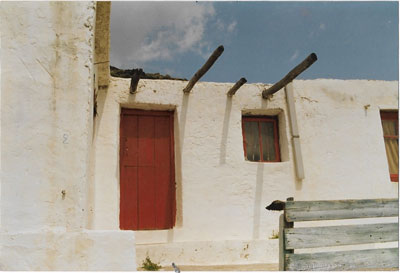
Close up of the front door, kitchen window and part of the veranda of the Cyclops Cave.
It is worth turning again, as a final afterthought, to Don Schofield’s braided memoir structure, as he notes in his book title. The interweaving and multilayered quality of his narrative is what intrigues the readers to delve into his life’s journey. The emphasis that From the Cyclops Cave places on its presentation as a multi-storied memoir and not as a non-fiction story preserves the personal touch of the overall endeavor as it moves beyond the fiction/non-fiction binary, which often pushes readers towards questioning whether what they have been reading is truthful or not. Based on William James’s statement that “truths cannot become true till our faith has made them so” (96), one is invited to acknowledge the relative quality of the truths that a memoir attempts to bring to the readers’ attention, which also explains why memoirs continue being so popular today. Such an observation becomes clear when turning to the following sentences taken From the Cyclops Cave: “In time, while still being cast to and fro, I eventually found a direction I wanted to row toward. But going forward, as I soon learned, also necessitated going back to those childhood years, from four to thirteen mainly, not just contemplating memories from those days, but also encountering yet again the people who shaped me back then, who made me, for better or worse, the person I am” (281). The narrator’s repeated reference to the personal pronoun “I” and “I am” endows this statement with extra vibrancy that lends itself to phrases such as “encountering yet again,” whose confrontational longing for facing and coming to terms with the past is where their truthfulness can be located. And this is exactly what Schofield’s braided memoir structure does: it pushes readers, alongside the speaking voice, into the moment each experience, of an event and encounter, unfolds itself, its tension builds up, its emotional energy becomes evident, its personalized straighforwardedness is manifested. In the words of Ihab Hassan’s, “the self is no mysticism: it empowers this discourse, any counter discourse, and all the vastations of history” (437). Thinking about this statement in tandem with From the Cyclops Cave, one realizes that the self can be understood only when it is no longer caved but seen as an animated and evolving entity in interaction with people and places and as an articulating voice that through language tries to verbalize all that has been lived and experienced. Schofield writes near the end of his book: “Now I’m hungry for awareness. And I’ve started listening. That’s what’s made the difference” (308). It is exactly this insatiable hunger for self knowledge that stimulates the senses and encourages a different understanding about one’s position in the world to be retrieved despite the hardships and sacrifices.
Indeed, From the Cyclops Cave manages to braid an array of counter narratives as a means of empowering the self which is also where the authenticity of Schofield’s memoir writing emerges from. The multiple transformations and subversions of the self’s own story and the ability of the narrative to synthesize all the fragments of memory into a meaningful whole offer the contemporary reader a promising narrative driven by the entanglements and complexities of the self. Even though the memoir focuses on a person’s own story, it is this person’s decision to make their voice heard that will continue making memoir writing both unique and enticing. This is where Schofield’s book manages to turn the cyclopean obstacles of the self into grounded wisdom of inner growth.
WORKS CITED
James, William. The Will to Believe and Other Essays in Popular Philosophy and Human Immortality. Dover, 1956.
Hassan, Ihab. “Quest for the Subject: The Self in Literature.” Contemporary Literature, Autumn, 1988, Vol. 29, No. 3, (Autumn, 1988), pp. 420-437, www.jstor.org/stable/1208455. 20 July 2026.
Schofield, Don. From the Cyclops Cave: a Braided Memoir. Open Books, 2025.
Stone, Albert E. Autobiographical Occasions and Original Acts: Versions of American Identity from Henry Adams to Nate Shaw. U of Pennsylvania P, 1982.
Worden, Daniel. “Memoir.” American Literature in Transition, 2000–2010, edited by Rachel Greenwald Smith, Cambridge UP, 2017, pp.125-137.
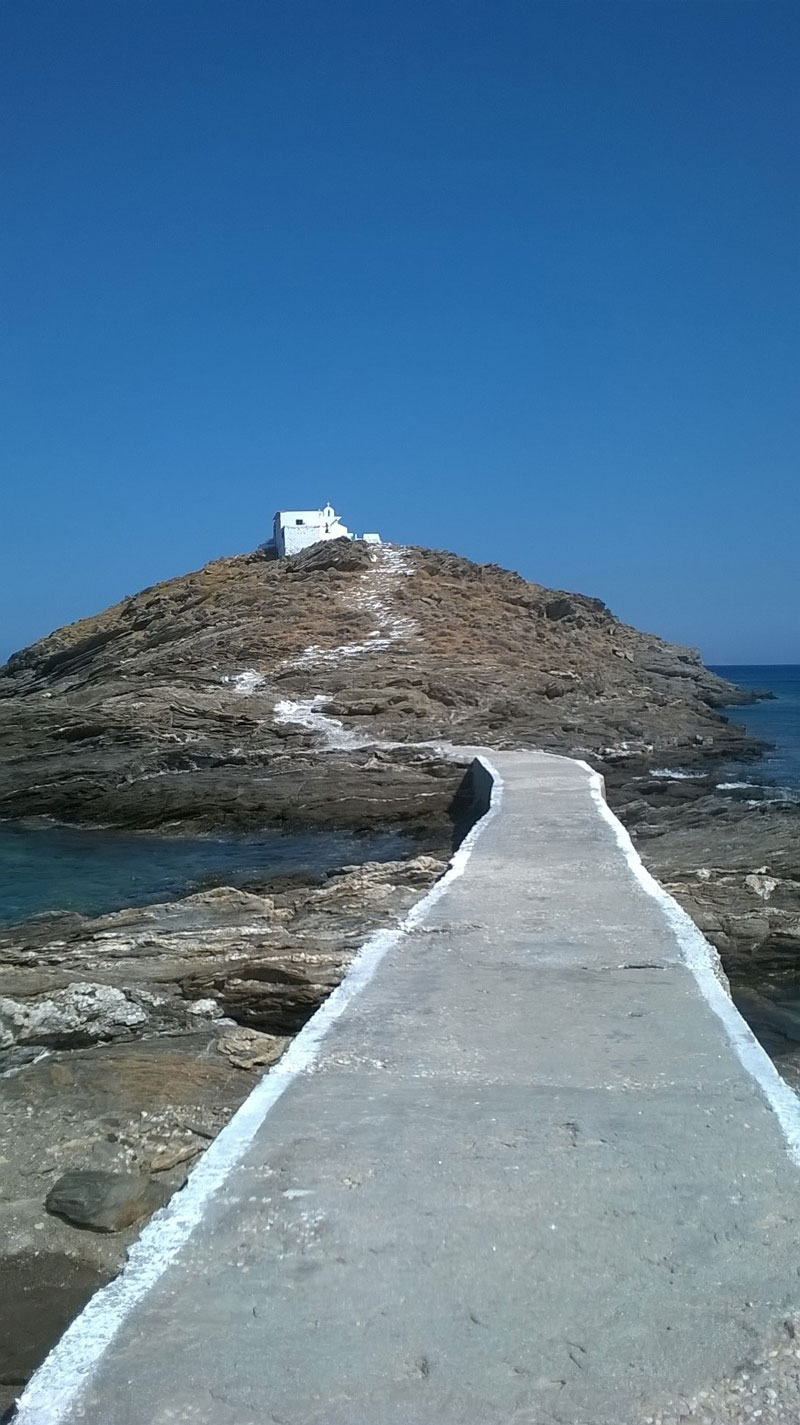
Primitive wooden gate separating Naoussa Bay from Kouri Bay.
[1] Don Schofield’s full profile and information about his oeuvre can be accessed in the following link: https://www.don-schofield.com/